
Transforming Discovery with Video
From zero to one: bringing short-form video into GetYourGuide to enrich how travelers discover destinations.
- Problem
- Travelers were leaving to Instagram and TikTok to plan trips. Could video make us the place they discover?
- My role
- Product Design Lead — strategy, sprint facilitation, end-to-end design
- Outcome
- MVP shipped in 2 months; 3 iterations over 12+ months, now part of the core experience
- Timeline
- MVP Q1 2024 · Team: PM, Data Analyst, FE/BE Engineers
Specific figures are omitted to respect my NDA — I've kept the directional results.
A brief that started with conviction, not a ticket.
Leadership asked us to explore authentic content — building on our success adding photos to reviews. The insight: travelers were increasingly turning to Instagram and TikTok to find activities and plan trips. That was our opening to differentiate.
My team owned two questions: how do we show these videos on our platform, and how do we measure their impact? Marketing moved ahead in parallel, commissioning influencers to make short-form vertical videos we could use across social and product.
This was rare for me — a project driven by leadership conviction rather than a proven user need. That shaped everything about how I ran it.
I designed it and I ran the room.
- Lead Product Designer — organized the design sprint, crafted user journeys and IA, designed and prototyped the experience, validated concepts, and helped set priorities across engineering teams.
- Sprint Facilitator — guided the week end-to-end and made sure we walked out with a working prototype.
Our HQ is in Berlin; the platform teams are in Zurich — so I took the team to Zurich for a week-long sprint to build one shared understanding.
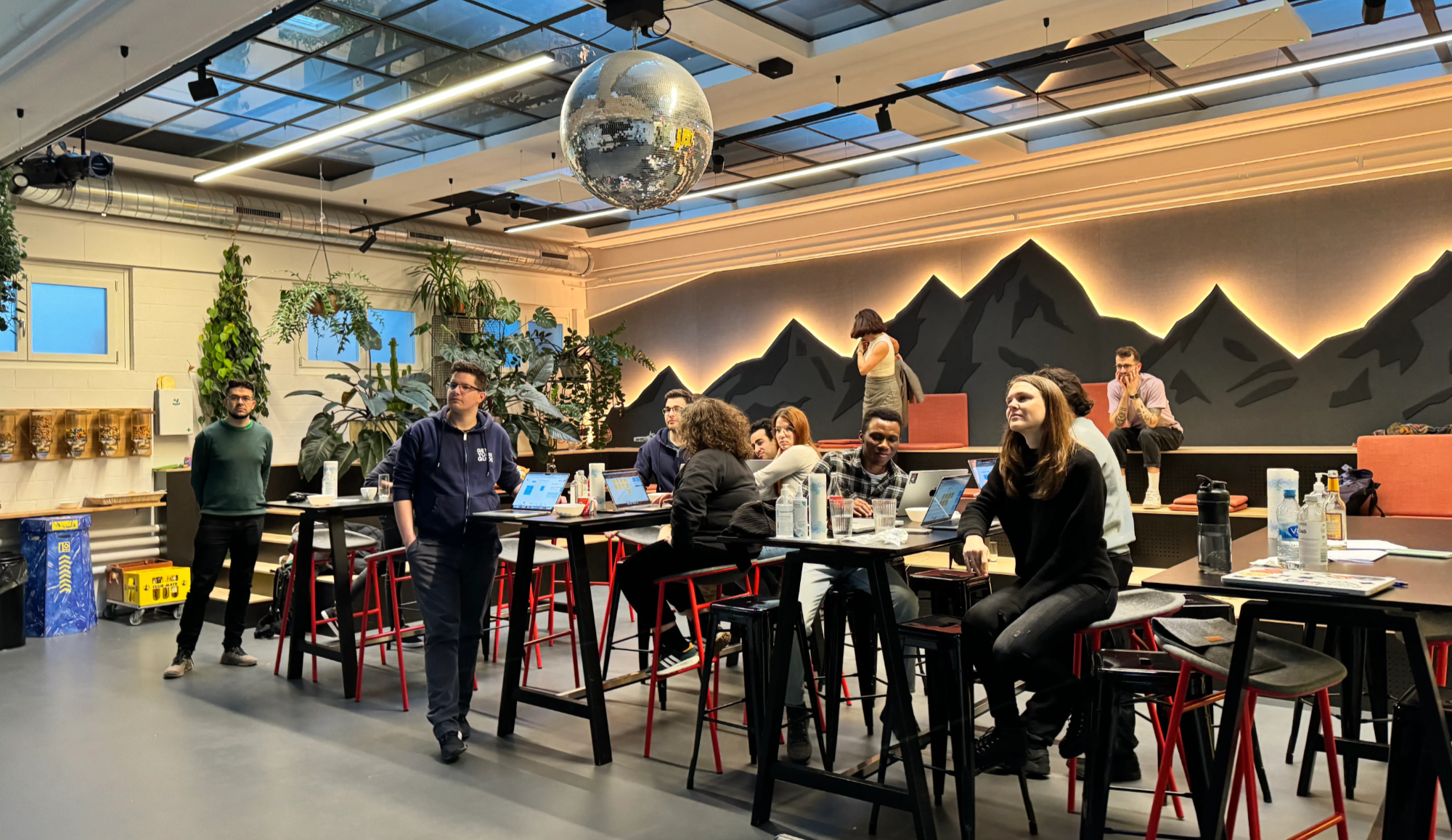
A five-day sprint, prepared for.
Before Zurich.
Two stakeholder sessions to pin the scope, plus consolidating our UX Research into one pack — user journeys, two personas, a competitive landscape, and short- and long-term goals — so I could represent the UX point of view in the room.
The sprint.
Understand → Ideate → Prototype → Validate. Nine speakers in lightning talks across Product, UX, Marketing, Data, and Engineering; then assumption analysis and solution sketching to reduce risk before we built. To close the loop I prototyped 35+ screens in two days so the user interviews had a real end-to-end experience to react to.
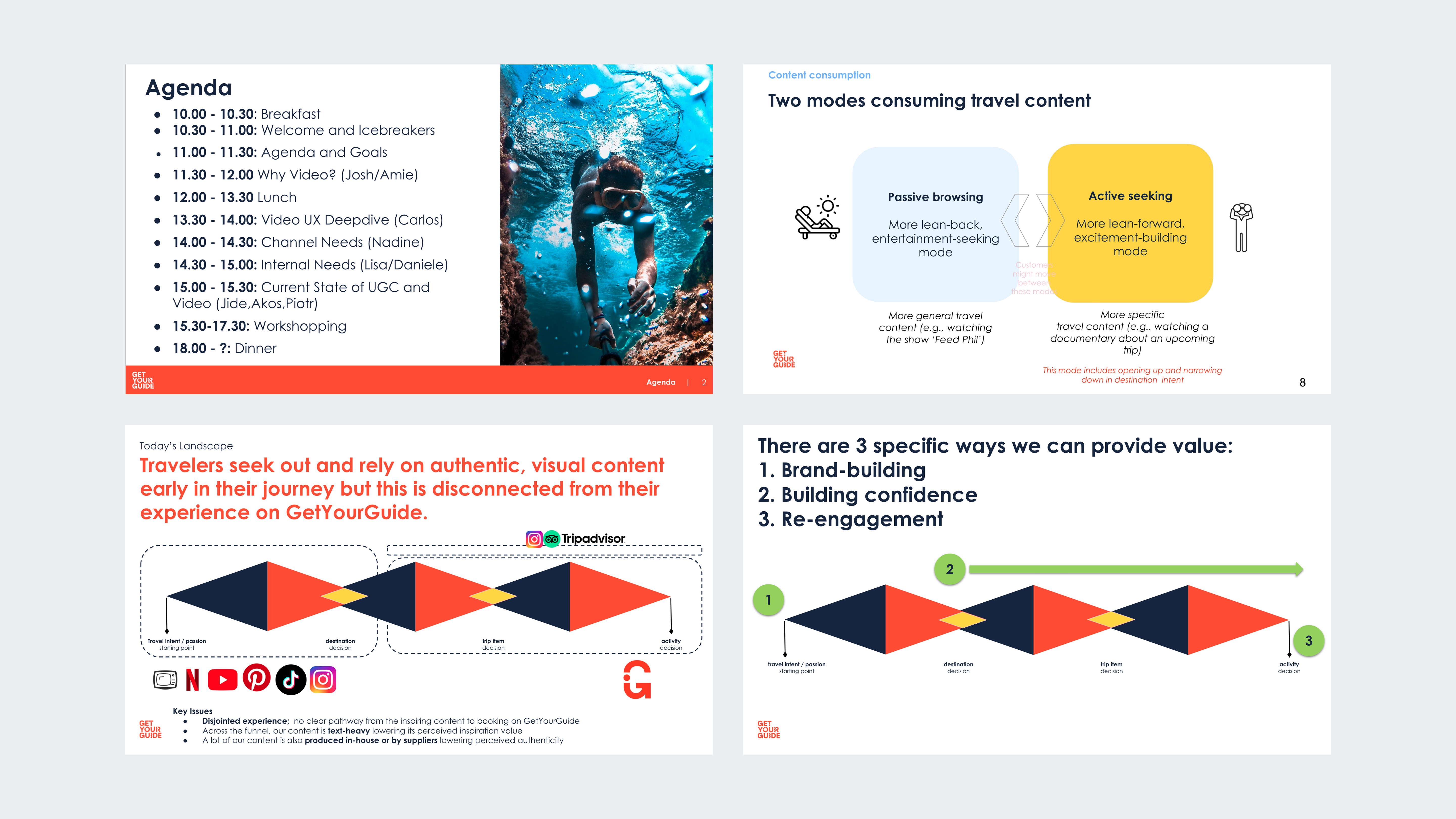
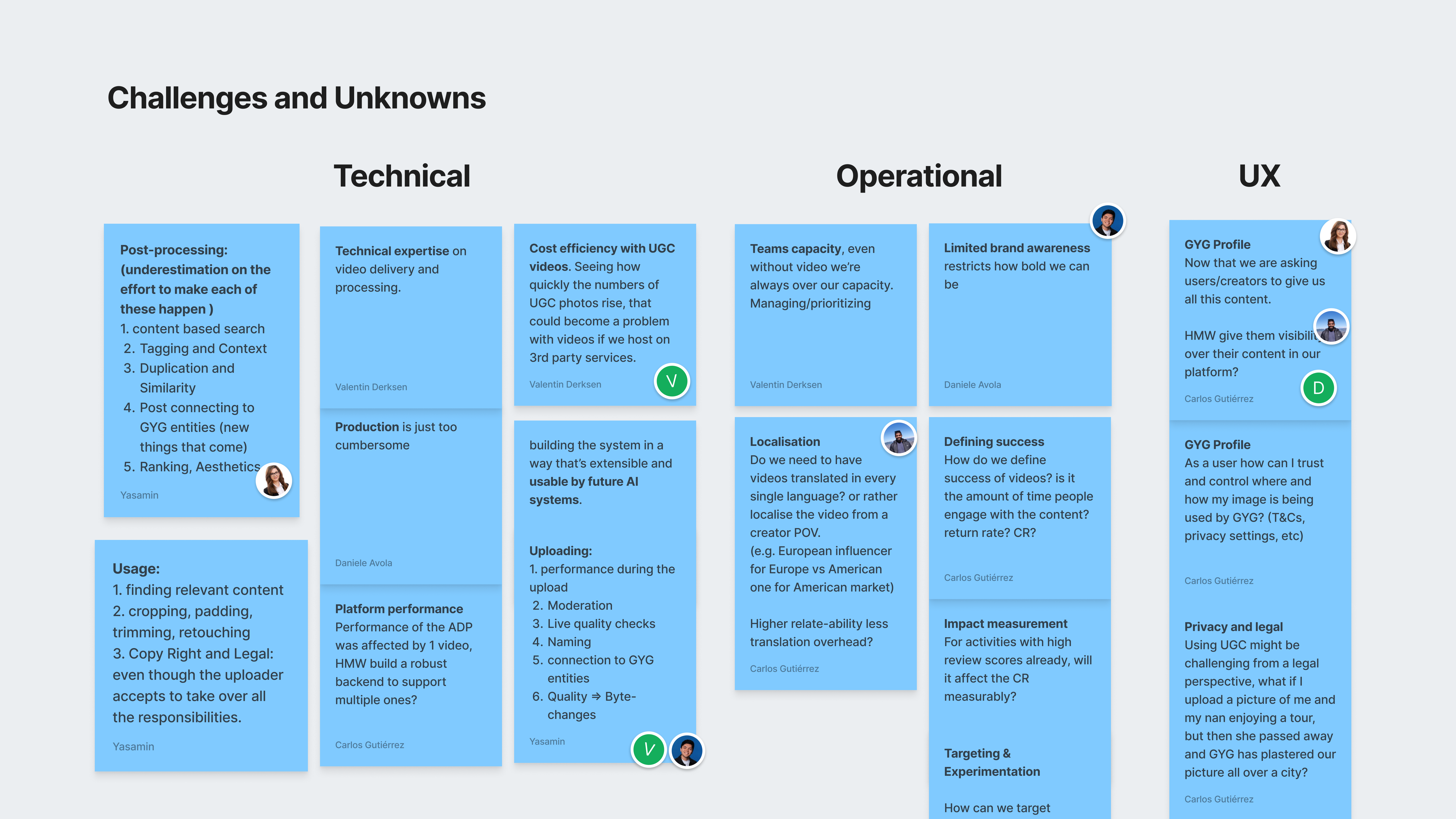
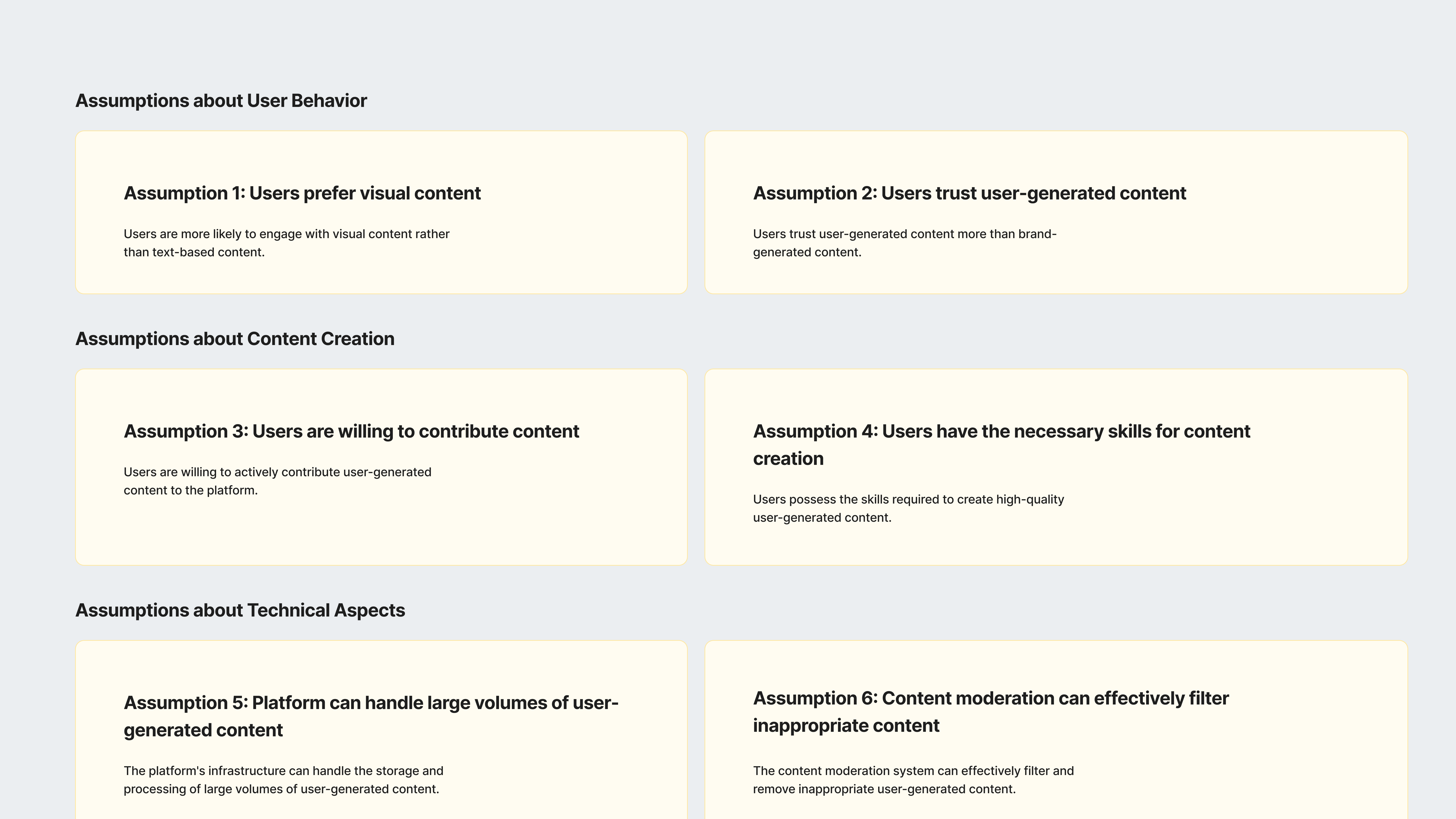
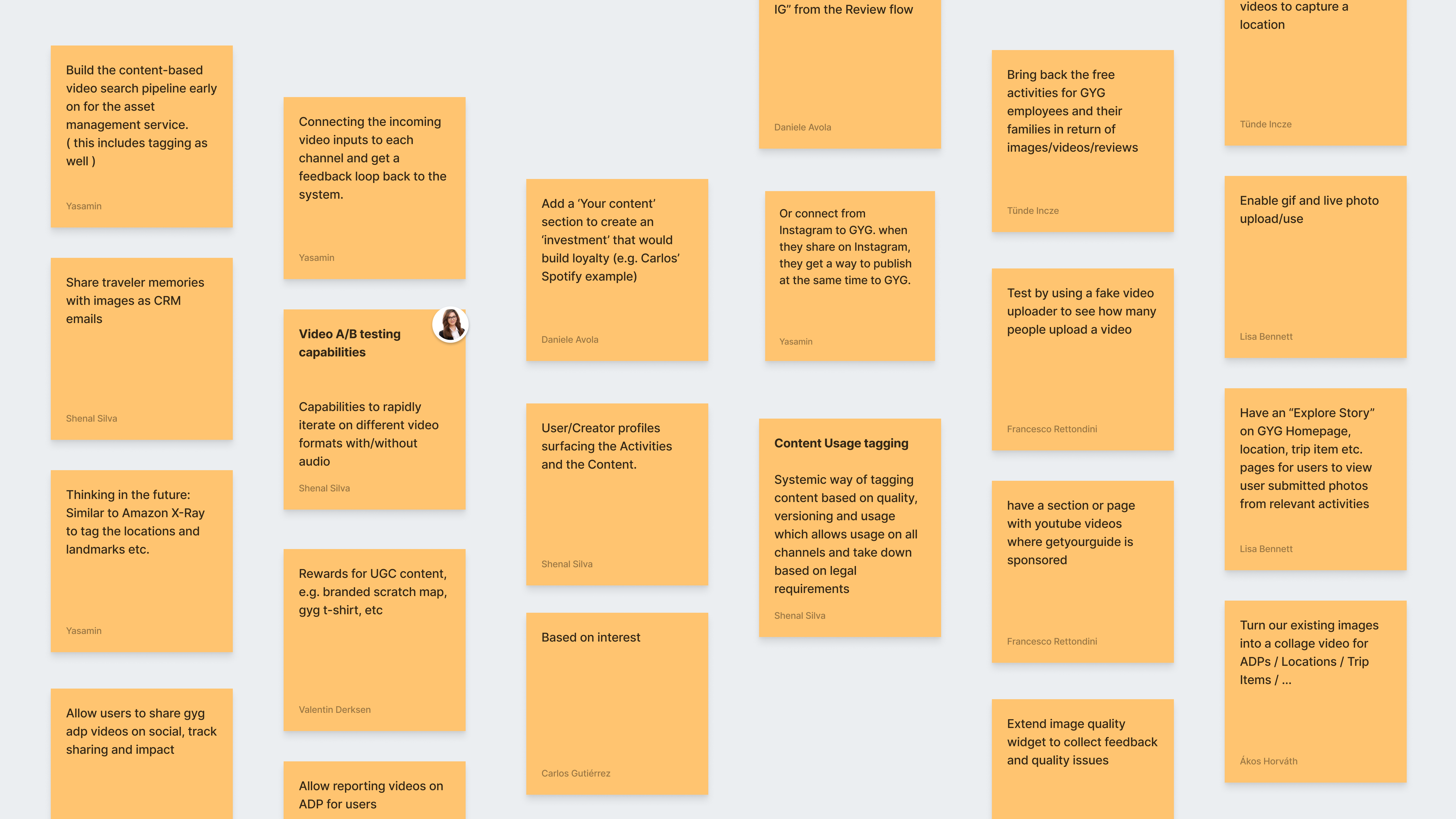
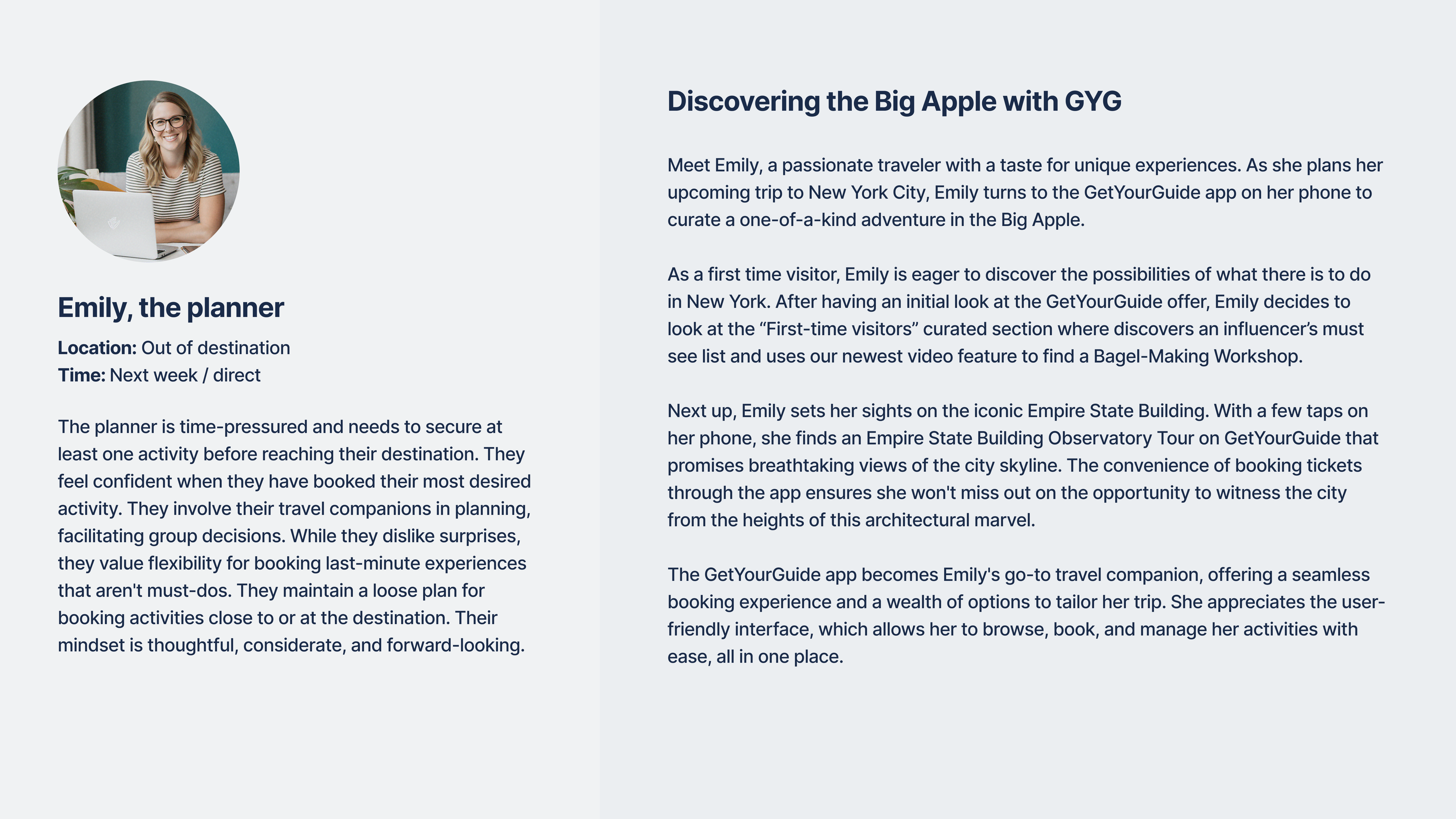
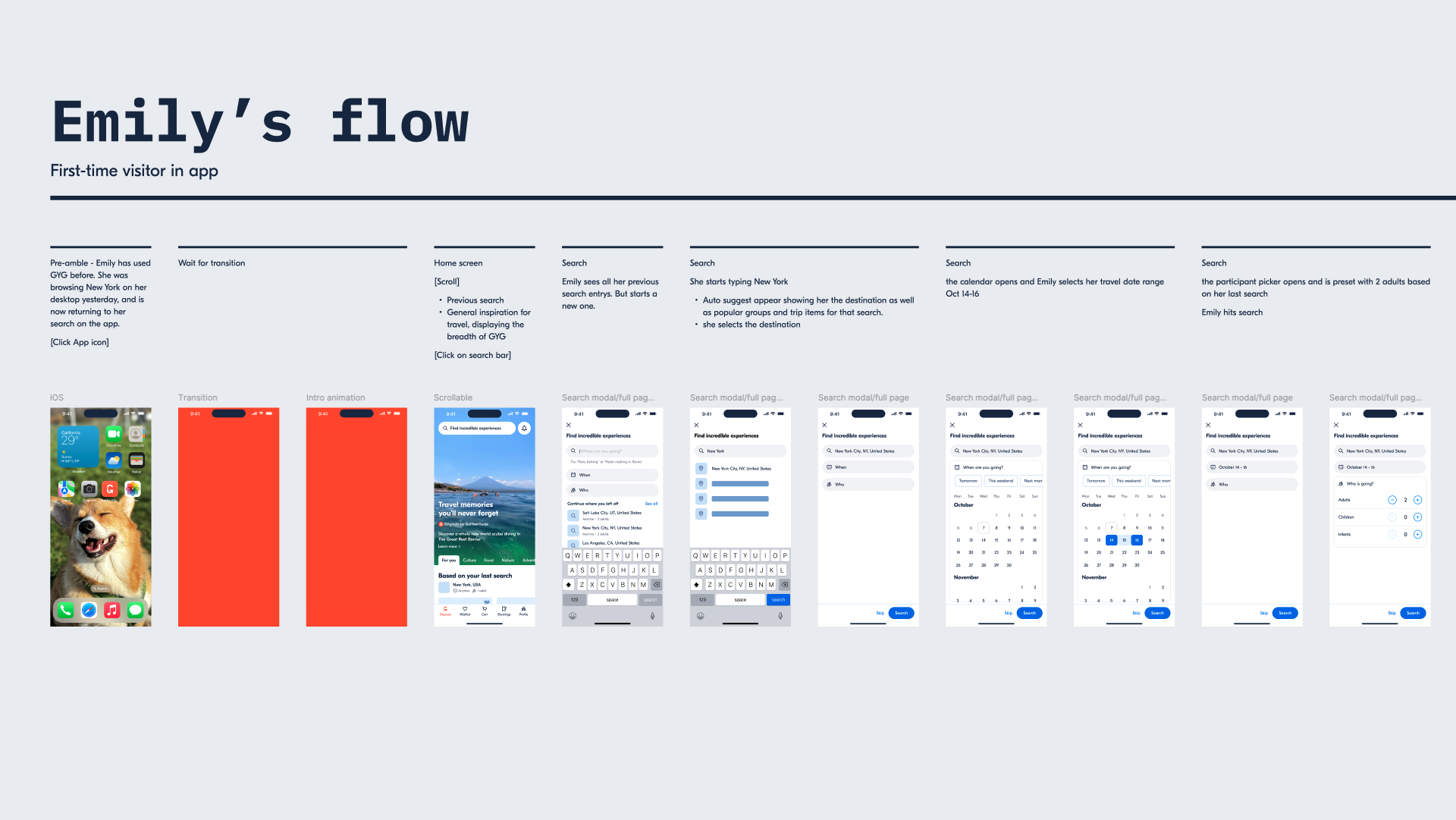
Concepts we explored: video on the home screen, Travel Collections, Traveler Moments (local/recent-visitor clips for hidden gems), video on Points of Interest, and video on the Activity Details Page (ADP).
What six users told us: they'd rather watch than read on the ADP — some said a good video alone could make them book — and they'd use Traveler Moments specifically for hidden gems.
Focus the bet: video where booking happens.
Given user signal and marketing's capacity to supply clips, we focused the MVP on video on the ADP, and I refined the design to scale across platforms.
- Flex gallery (mobile) — a new gallery grid to hold the vertical 9:16 format; we shipped this alone first to de-risk before adding video.
- Core video experience — a full media player with subtitles and creator attribution, plus a Check availability button that dropped users straight into the booking assistant for a faster path to purchase.
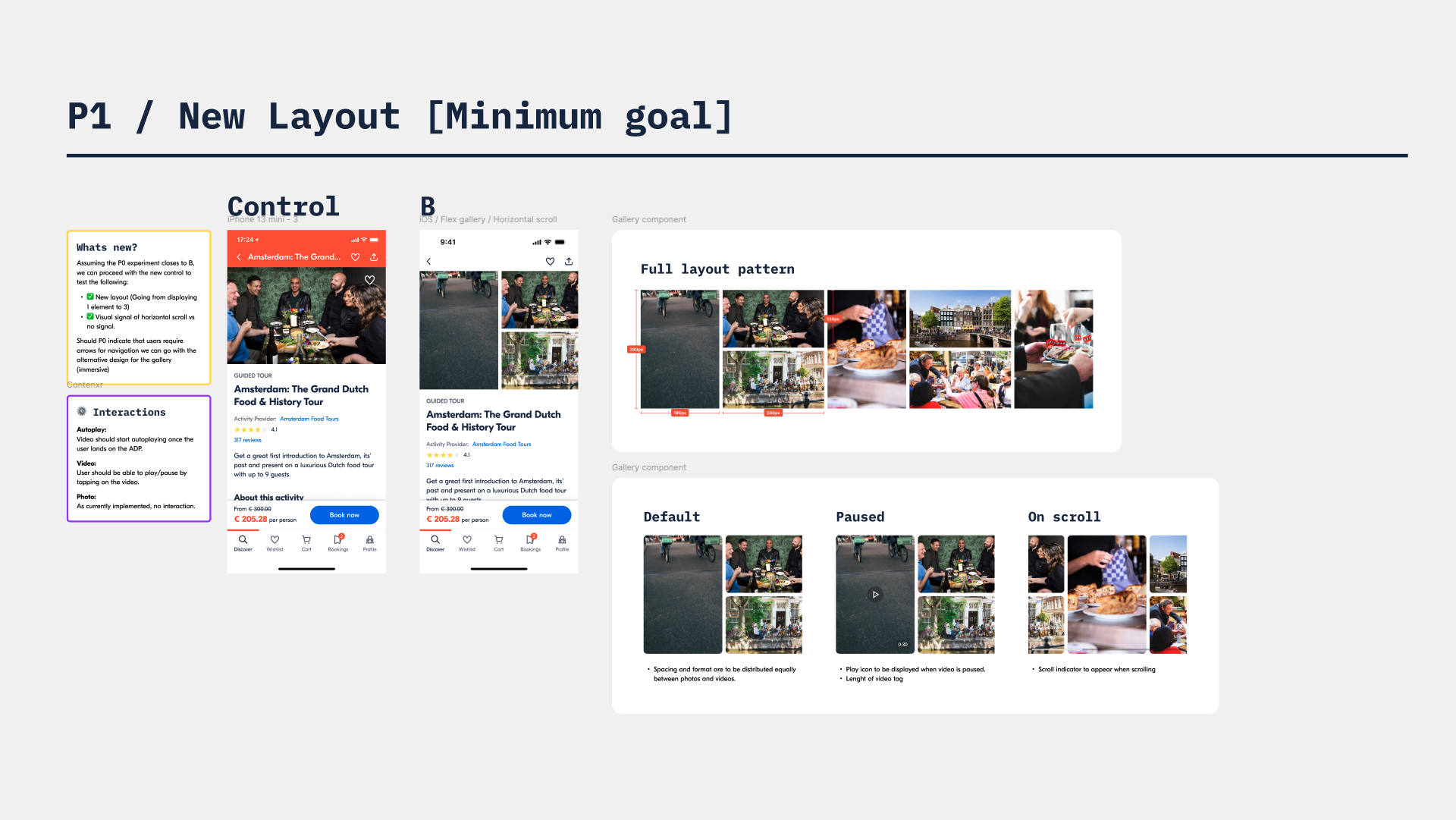
Built with engineers and stakeholders in two-week agile sprints — MVP live in two months.
Directional wins, and an honest read.
- Engagement: users watched videos in full on first view, and up to 30% again on a second viewing.
- Return rate: people came back to ADPs with video more often, and spent more time there — suggestive of a conversion link, though we couldn't prove causation.
Being straight about uncertainty matters: the primary metrics didn't clearly move at first, which set up the next iterations.
One sprint became a 12-month workstream.
- V2 — video on Destination pages. Hypothesis: ADP visitors may have already decided, so video couldn't sway them. We built a module with title, supporting text, and CTAs.
- V3 — multiple videos on Destination pages. After V2 lifted primary metrics, we went mobile-first with three videos per destination and a new browsing experience to test conversion on featured activities.
- Today: video is part of the core experience (not yet every destination/ADP) while marketing tests which formats perform best before scaling.
What I took from it.
- I'd anchor to a customer problem. Starting from leadership conviction was a great chance to innovate — but tying the feature to a known user need earlier would have given us the clarity to move faster and truer.
- Not only KPIs matter. It was rewarding to ship something that delighted both travelers and our supply partners, even where the headline metric was ambiguous.
- Ownership travels. Running the sprint in Zurich pulled two locations into one team — a reminder of how much good happens when you make space to collaborate in person.
The best outcome wasn't a metric — it was two offices becoming one team.
 Say hi
 Let’s connect
 Get my CV